Sit by a retaining pond
which held back the flood
Or, if your hand is steady
raise a spoon of clear water
one which carried food
to your family's lips.
Sit quietly, as you would
to honor one confessing their grief
or declaring their joy.
Stay mute as you consider
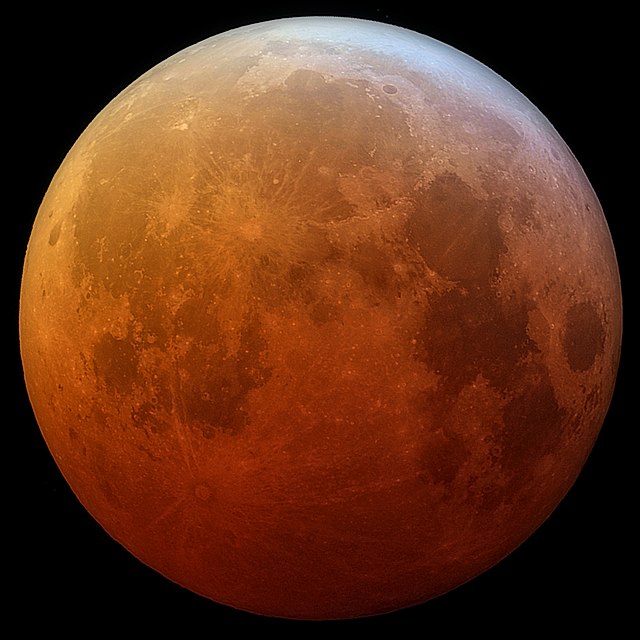
this moon's twin in the pool,
its study in the spoon.
You do not influence its orbit,
its temporary coral hue,
nor its inclination to hide
for an hour or two
in your shadow.
But, you may think
of everyone you wish
to carry to safety.

Before you begin:
vote.
Photo attribution, Creative Commons 0, Public Domain Dedication by Giuseppe Donatiello from Oria (Brindisi), Italy
A poem for Emily Dickinson on Her birthday, December 10
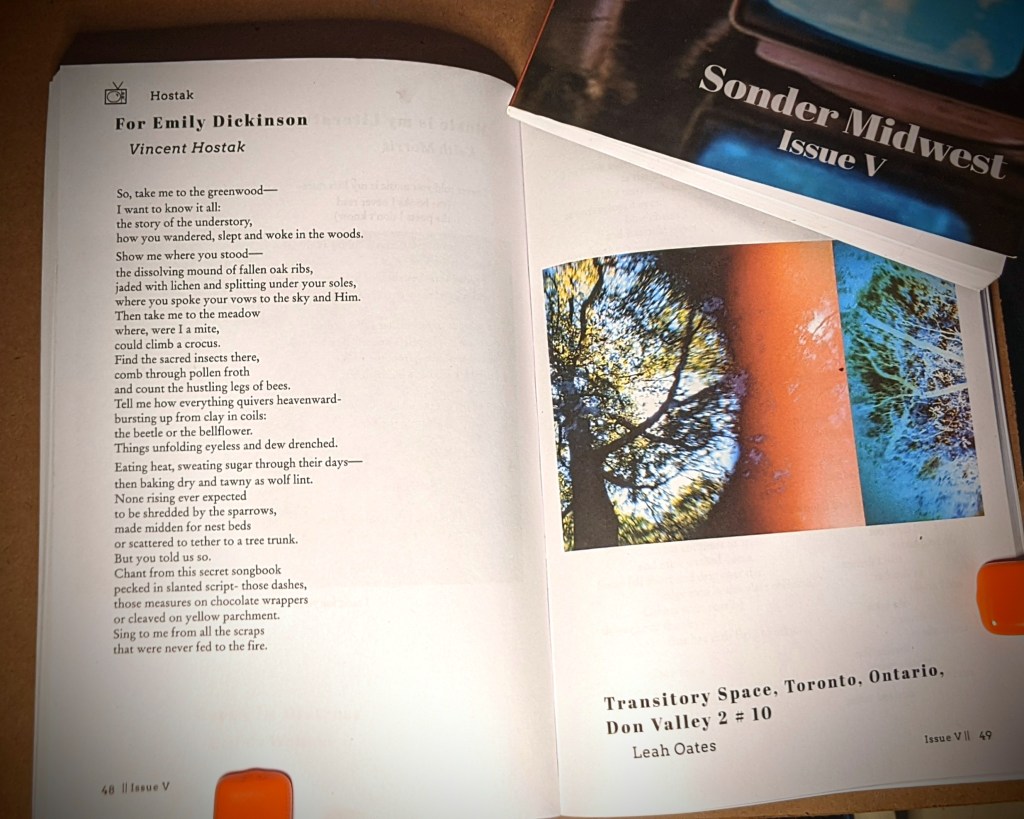
In late 2019/early 2020 I wrote the following poem in and around Emily Dickinson’s birthday. “For Emily Dickinson” was published to Sonder Midwest, Issue V in Spring 2020 where it was paired to a facing page featuring the powerful and innovative artwork of Leah Oates. Sonder Midwest: https://sondermw.com/issues-2/
As for the poem, the observations of the tireless twitching of the natural world in the transition from Spring to Summer could have come from my own backyard. I made little effort to borrow Dickinson’s voice, except to imagine her Greenwood, which appeared in one of her very early poems. It is a 13th Century term for the woodlands and often a den for outlaws. Of course, ours’ is an original Outlaw Poet, long before Ginsberg, Corso and Waldman. She lived near Amherst, where she likely wandered into her Greenwood and maybe even sometimes napped upon its mulchy floor. The rest of it comes from the American West where I live and Spring to Summer days vary from still to vigorously windy, snowy wet to spells where things bake and become as “tawny as wolf lint.” An mp3 recording of a reading is included below.
As it was read by the poet in 2020 at a Landon Review of the Arts in Texas: Tejascovido gathering of poets
Notes, Two Things I Borrowed:
The Dash: Her manuscripts have dashes that are short and longer, often represented in typography as “-” and “–“. Scholars of her work will long postulate on the meanings of the ciphers. Personally, I think they just work to add rhythmic color to your silent reading across the stanza. The dash and longer dash has been adopted by many contemporary writers. I don’t read to much into this “comma with more drama.”
Him (?): “Him” is a reference found in Dickinson’s poems, such as “I could suffice for Him, I knew” (643). The protagonist is in conversation with god/a greater presence, using the symbolic notation of poets before her for that presence. Like others, I don’t read it as explicitly signaling a being, let alone a gendered one. She was appreciative of the place of the human in the natural and spiritual or metaphysical world, perhaps a transcendentalist. In fact, poem (643) explores the questions of “Would I be Whole (?)” without nature or humanity, as if it were asked by god/a greater presence. I suppose these identities would have helped the reader contemporary to the time. Readers, you say? While she published only ten poems in her lifetime, she embedded her verse in letters to private, trusted readers like writer and abolitionist, Thomas Wentworth Higginson and certainly Susan Huntington Gilbert Dickinson.
Capitalization: You can find other manifestations of energy in her universe, capitalized, both elemental varieties and some things greater: the Sun, Nature, “the furthest Star.” Here she addresses the Moon, personified as Her, in the same Poem (643) :
The Answer of the Sea unto The Motion of the Moon— Herself adjust Her Tides—unto— Could I—do else—with Mine?
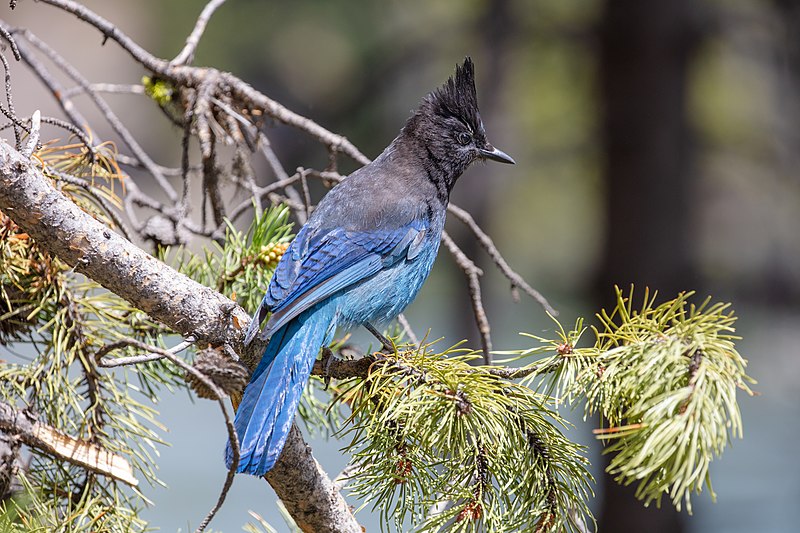
I do not blame the Steller Jay
for all my frenzied sleeplessness.
She seems enamored with concerns
pecking by the window ledge.
l'm grateful for her restlessness.

Within her anxious struggling
there works a skillful sorceress
enchanting from these toughened hulls
abundance in each shell concealed.
It's not her fault - my busy mind.

Now rise into a cobalt plume,
break from the guard you've fastened here,
and heave all husks into the air.
Disturb and nourish others, Jay,
who cry for lifted hearts today.
Notes:
Steller’s Jay is an American Corvid found in the North American West, particularly in the Rocky Mountains. Sociable and intelligent, they can be observed easily in these parts. Pairs nest for life. Female and male Steller Jay’s are not easily differentiated, as all have the same bold colors, similar loyal behaviors, and an color appearance of graduated blues across the body to a blacker head with the same distinctive crest. They may be characterized, far too generally, as “aggressive.” Protective of nests, their family and social groupings (flocks) are probably more accurate, and less judgmental, perspectives. They have been known to flock with other species, so “territorial” doesn’t fit and, in my opinion, is a holdover from patriarchal biases in the language of natural history. They are non-conforming in many ways that we humans tend to categorize all inhabitants in this world: how they look, gender roles, behavior in groups, and even how they sound. Songs are at one time “harsh” and another “melodious.” They can channel the sounds of other birds, even raptors. Call them Kwish-kwishee, as named by first peoples of the Pacific Northwestern Coast, the Makah. There is a context of “rakishness” connecting these birds appropriately to the original mythologies of the continent. Look up: how Kwish-kwishee got it’s crest.
 Wild, Abandoned
You must be logged in to post a comment.